What is a Korean ingredient kit?
At Korea Store, an ingredient kit brings together several Korean grocery products around a recipe or a use, at a lower price than the same products bought separately. These are grocery products in jars, bottles or sachets, meant to be used in cooking, and not a ready-made dish.
The word “kit” can refer to different things: a fermentation kit contains equipment, whereas a meal kit may include fresh ingredients. Here, the Korean cooking kit corresponds to groceries that are stable at room temperature.
The range is divided notably into recipe kits, essentials kits, producer kits and seasonal kits. It is a way of starting out with a coherent selection rather than putting together each product yourself one by one.
What is in a kit, and what is not
A kit brings together shelf-stable grocery products: fermented pastes such as gochujang or doenjang, sauces such as ganjang or jjajang sauce, dry bases, oils, vinegars, noodles, tteok, seaweed or rice depending on the kit. To better identify the essential ingredients of the Korean pantry, see our guide to the 9 basic ingredients for cooking Korean.
The common rule is simple: no fresh produce goes into the kits. You therefore need to buy in addition the meat, fish, vegetables, eggs or fresh tofu required for the recipe. Korea Store does not ship any refrigerated products: the kits are made up of products that can be shipped and stored without a cold chain.
Before opening, the products stay at room temperature according to the instructions on their packaging. To cook, you also need the cupboard basics: cooking oil, garlic, salt, sugar, as well as a frying pan or a saucepan.
Which kit for which dish?
The simplest way is to start from the dish you want to make:
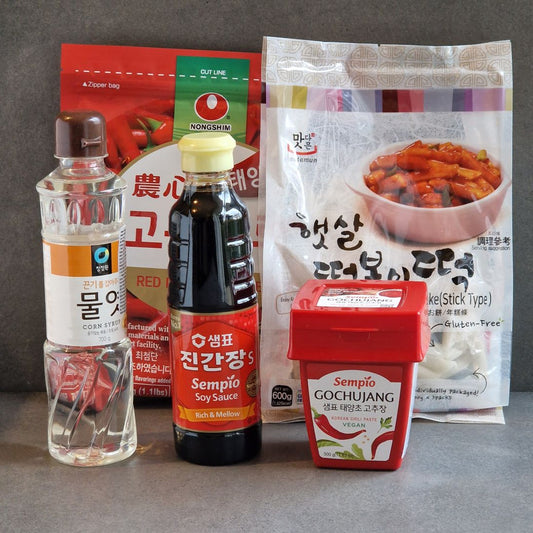
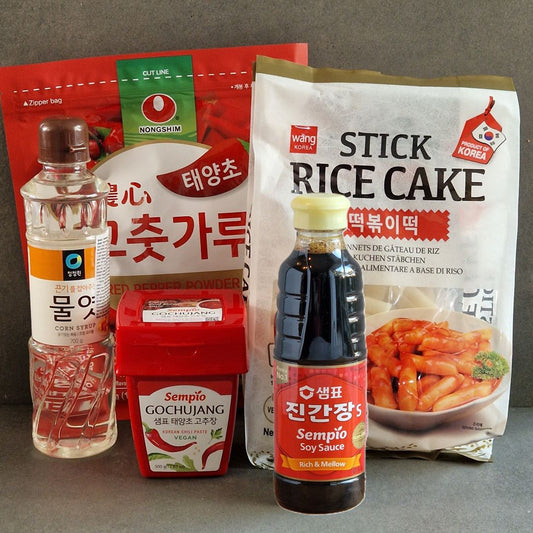
- Tteokbokki — The kit provides: the tteok, the chilli paste, the sweet-and-salty base. Still to buy: nothing essential; egg and spring onion depending on the preparation.
- Homemade kimchi — The kit provides: the chilli powder, the salty fermented base, the rice flour. Still to buy: napa cabbage, radish, coarse salt.
- Korean fried chicken — The kit provides: the flour, the chilli paste, the soy sauce, the sesame oil. Still to buy: chicken, frying oil.
- Mandu — The kit provides: the dumpling dough, the seasoning, the long-life tofu. Still to buy: minced meat or vegetables for the filling.
- Korean barbecue — The kit provides: the marinades, the ssamjang. Still to buy: meat, lettuce for wrapping.
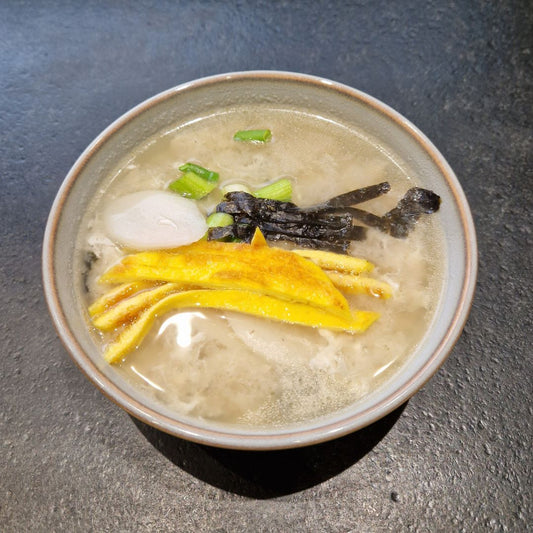
- Tteokguk — The kit provides: the sliced tteok, the broth, the seaweed. Still to buy: beef, egg.
- Gimbap — The kit provides: the seasoning bases and the associated grocery products. Still to buy: the fresh ingredients for the filling.
- Kimchi jeon — The kit provides: the grocery ingredients needed for the preparation. Still to buy: any fresh ingredients.
- Bibimbap — The kit provides: the seasoning bases and dry products. Still to buy: vegetables, egg and other fresh toppings.
If your goal is tteokbokki, head for the kit for tteokbokki. To make homemade kimchi, the kit for homemade kimchi brings together the corresponding grocery bases. And for fried chicken, the kit for Korean fried chicken lets you start directly from the products needed for the seasoning and the preparation.
The sizes are those of Korean grocery products intended for several uses: you will notably find 500 g jars and 860 ml bottles. A kit therefore does not necessarily correspond to a single preparation.
Kit or separate products: how to choose?
The Korean cooking kit is above all relevant when you are starting out and the cupboard is empty. It saves you having to identify several Korean ingredients on your own and limits inconsistent purchases, such as confusing gochujang, a fermented chilli paste, with gochugaru, dried chilli flakes.
Conversely, the kit can be redundant if you already have the main products. Someone who has their gochujang, ganjang and sesame oil will sometimes be better off buying only the ingredient or ingredients they are missing.
The size matters too. Korean sizes are large for a French cupboard: this is worthwhile when you plan several preparations, but less suitable if you simply want to try an ingredient once. In that case, buying individually lets you build up your pantry gradually.
To make several dishes after a first purchase, the homemade kimchi recipe shows precisely how certain grocery ingredients can then go beyond the scope of the kit.
Storing and using your kit
A kit left closed until the “right moment” is not of much use: the products are grouped together precisely so that they can be used gradually. Before opening, keep them at room temperature, away from light and moisture, respecting the best-before date or the date of minimum durability shown on each package.
After opening, two rules apply. Fermented pastes and sauces are kept in the refrigerator according to the manufacturer’s instructions. Dry products, for their part, stay at room temperature in their properly resealed sachet or in an airtight box. Putting them in the refrigerator is not necessary and can encourage condensation.
A kit should therefore not be seen as a set that must be used in order. Once opened, each product can be used in other Korean recipes. The products are shipped from France with no cold-chain constraint on delivery.

 Sold out

 Sold out

 Sale
 Sold out

 Sale
 Sold out

 Sold out
 Sale