Korean ramen or ramyeon: what are we talking about?
In Korea, instant ramen is called ramyeon (라면). The term mainly refers to precooked wheat noodles accompanied by a powdered broth and dehydrated vegetables, to be prepared quickly in boiling water. Ramyeon developed in Korea in the 1960s as an affordable, quick everyday food.
The word “ramen”, however, comes from Japan, whose soup noodles themselves stem from a Chinese influence. Japanese ramen and Korean ramyeon therefore do not refer to exactly the same type of dish. Japanese ramen is often prepared around a broth that is worked on at length, with fresh noodles and toppings, whereas Korean ramyeon is mostly associated with instant noodles and spicy broths.
In Korean recipes, the spiciness comes notably from gochugaru, Korean chilli powder, and sometimes from gochujang, fermented chilli paste. Depending on the product, the broth can also highlight beef, seafood, kimchi or other, creamier profiles.
Soup ramen or stir-fried ramen: the two families
Korean ramen can easily be divided into two main ways of preparation: tang, when they are served with their broth, and bokkeum, when they are drained and then mixed with a thick sauce.
Soup ramen, or tang, notably includes Shin Ramyun, Neoguri and kimchi ramen. The noodles cook directly in the broth, with the seasoning sachets and the dehydrated vegetables. Kimchi jjigae is also a Korean dish in which instant ramen can find its place.
For a stir-fried ramen, the noodles are first cooked in water, then drained before being mixed with the sauce. This is the principle of Buldak and Chapagetti. You then need to keep a few tablespoons of cooking water before draining the noodles in order to adjust the texture of the sauce.
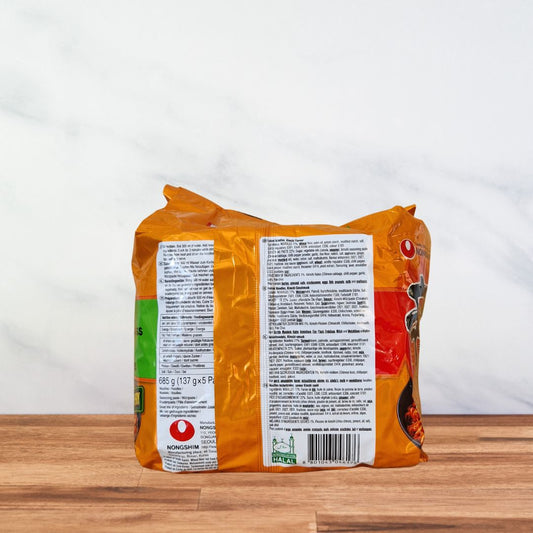
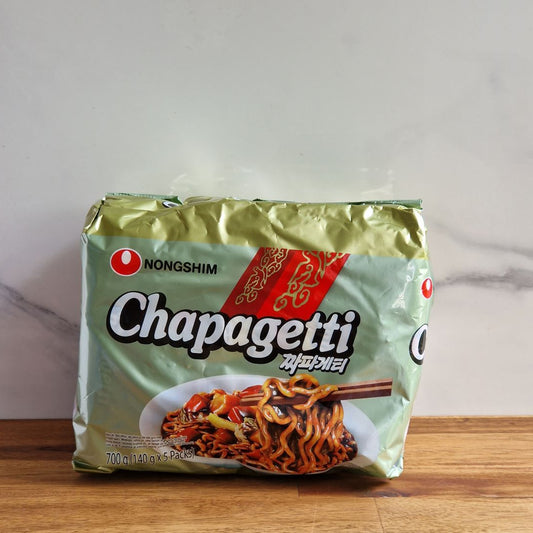
Chapagetti holds a special place: it is an instant version inspired by jjajangmyeon, with a sauce based on black soybean paste. It therefore belongs to the stir-fried ramen, but its profile is barely or not at all spicy depending on the preparation.
Which Korean ramen to choose according to your taste for heat?
The level of heat is an important criterion when choosing a Korean ramen, but the range also lets you vary the profiles. To start gradually, Ottogi’s mild Jin Ramen offers a less spicy preparation. Shin Toomba then brings a creamy texture and a rosé note that softens the perception of the chilli.
Shin Ramyun is a classic reference with its beef broth and its intermediate level of heat. Shin Tom Yum, for its part, combines chilli with an acidity inspired by Thai cuisine. Shin Black offers a richer broth, with a deeper dimension.
For those who like stronger preparations, Shin Red Super Spicy markedly raises the level of chilli, while Samyang’s Buldak ramen are among the spiciest products in the collection.
There are also profiles less centred on chilli: Chapagetti, vegetable ramen and certain vegetarian products. Kimchi ramen, Shin Toomba, Shin Tom Yum and Shin Black also let you vary the tastes without staying with a single broth profile.
How to prepare and improve a Korean ramen?
The classic preparation of a Korean ramen remains simple: bring the volume of water indicated on the packet to the boil, add the noodles and the seasoning sachets, then cook generally 4 to 5 minutes depending on the product. For a soup ramen, the noodles stay in their broth until serving.
Korean ramyeon also lend themselves very well to customisation. An egg, melted cheese, spring onion, kimchi, a few pieces of tteok or sheets of gim change the texture and the profile of the dish. To vary your preparations, see our instant ramen recipe ideas.
For a creamier preparation, our recipe for creamy ramen with tteok and egg combines instant noodles, tteok and egg in a preparation suited to home cooking.
For stir-fried ramen, the method is different: cook the noodles, keep 4 to 8 tablespoons of cooking water, then drain before adding the sauce. This water loosens the preparation and coats the noodles better. This technique is particularly useful with Buldak or Chapagetti.
Ramen can also be part of more complete dishes. Chapaguri, for example, combines Chapagetti and Neoguri. Ramyeon can also be added to a budae jjigae to make a more substantial meal.
Our selection of Korean ramen at Korea Store
The collection brings together 27 varieties of Korean ramen, in several formats: individual sachets, pots and cups, as well as packs of 5. It notably includes the brands Nongshim, Samyang and Ottogi, with profiles ranging from mild ramen to very spicy products.
The sachet corresponds to the classic preparation in a saucepan. The pot or cup lets you prepare a ramen without using a saucepan, notably at the office or when you are looking for a practical individual format. The pack of 5 suits the products you eat regularly.
The range also includes a ramen anti-waste box, offered depending on the availability of the collection.
Instant ramen are dry products that keep at room temperature and do not require a cold chain. Korea Store therefore does not offer refrigerated delivery for these products.
To complete your selection of noodles, sauces and condiments, discover our savoury Korean grocery.