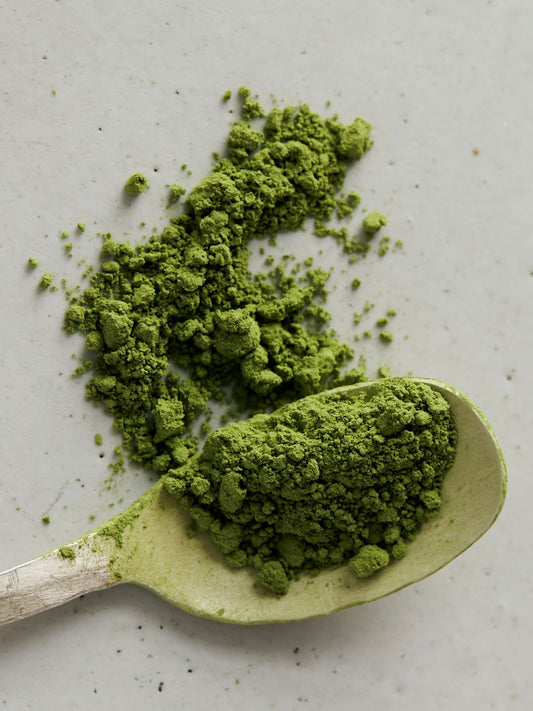
What is Korean matcha (malcha)?
Malcha 말차 is the Korean word for green tea ground into powder and then whisked in water. It is the same term of Chinese origin as the Japanese matcha, but read according to the Korean pronunciation.
It should be distinguished from nokcha 녹차, which refers more broadly to Korean green tea, particularly when it is consumed in leaf form. Malcha therefore corresponds to a specific use of green tea: the leaves are processed and then ground to obtain a powder that is consumed directly in the drink.
In South Korea, two regions are particularly associated with tea growing: Jeju, a volcanic island south of the peninsula, and Boseong, on the mainland. The matcha offered here comes from a farm in Seogwipo, on Jeju.
Korean matcha or Japanese matcha: what really changes
Japanese matcha and Korean matcha share the principle of green tea ground into powder, but their production practices and their market are not identical. In Korea, shading is generally shorter, which contributes to a more vegetal profile, with fewer marine notes and less umami. The taste nevertheless depends on the harvest, the process and the grinding.
Another important difference: Korea does not officially recognise the concept of “ceremonial grade”. Categories such as ceremonial, premium or culinary belong mainly to the Japanese commercial classification and do not constitute an official Korean grid. To choose a Korean matcha, it is therefore better to look at concrete criteria: harvest period, shading duration, fineness of the powder, colour and manufacturing process.
The result is a different taste profile, not a ranking between two origins. Korean matcha may thus appeal to those looking for a green tea powder with a round, vegetal taste, while lovers of Japanese matcha will find their own bearings in other profiles.
How to prepare Jeju matcha
To prepare this matcha powder, allow 1 g for 100 ml of water at 80-85 °C. The water must not be boiling: too high a temperature is one of the main causes of bitterness. Pour the water over the powder, then whisk until you obtain a smooth texture and a fine foam.
This matcha can also be prepared cold: its very fine powder dissolves in cold water without leaving any notable deposit. It is a practical option for an iced matcha, particularly in summer drinks and the recipes in our selection of Korean summer recipes.
For a matcha latte, the sticks are designed for a different preparation: one stick in 50 ml of cow’s milk or plant-based milk. The powder can also be used in certain culinary preparations, but its fine, vegetal profile is better suited to recipes where the matcha remains perceptible than to batters heavily loaded with ingredients.
The powders keep at room temperature, away from light and moisture. Korea Store does not ship refrigerated products.
Sticks, 50 g tin or 500 g pouch: which one to choose?
The three formats in the range correspond to three different uses, and the sticks must above all not be confused with pure matcha.
- The sticks – €15: each stick contains a blend made up of 40% matcha and plant-based sweeteners. They are designed for quickly preparing a latte. It is therefore not pure matcha.
- The 50 g metal tin – €49: it contains 100% pure matcha, with no sugar or additives, with a measuring spoon. At 1 g per preparation, it makes about 50 cups.
- The 500 g pouch – €135: it contains the same pure matcha and is intended rather for cafés, tea rooms and professional or regular use. For this use, see our Korean grocery for professionals.
For a first discovery of Korean matcha, I would start with the 50 g tin: it lets you taste the pure matcha, try the hot or iced preparation and master the dosage before moving on to a large format.
Glossy Matcha, our producer on Jeju
Glossy Matcha is based in Jocheon-eup, in the north-east of Jeju. The house was originally a café known for its matcha creations before developing its own production. Korea Store met it in January 2025 at a trade fair.
The leaves used come from an ecological farm in Seogwipo, grown without chemicals. They are young spring shoots (first flush) from a single field. They are shaded for three weeks before harvest, then steamed and slowly dried at low temperature. Stem and vein removal is done by hand before grinding on a stone mill.
The workshop is HACCP certified. To discover the product corresponding to the pure matcha in the collection, see the pure Jeju matcha in a 50 g tin and our approach through our selections of Korean products.