What is dangmyeon (당면), the Korean sweet potato noodle?
Dangmyeon (당면) is a Korean noodle made from sweet potato starch, not from fresh sweet potato. Uncooked, its strands are grey and brittle; after cooking, they become translucent, supple and elastic, with a characteristic chew. This texture allows them to absorb sauces while separating well.
Korean sweet potato noodles are naturally gluten-free, since they contain no wheat flour. They hold an important place in Korean cuisine, notably in japchae, but also in certain soups, stews and cold dishes.
Please note: “sweet potato noodles” here refers to a noodle made with sweet potato starch, not strips of fresh sweet potato made with a spiralizer. To round out your pantry, also see our guide to the basic dry ingredients of Korean cuisine.
Dangmyeon, glass noodles, mung bean vermicelli: how to tell them apart
Glass noodles, or glass noodles, are a general category of noodles that are transparent after cooking. Dangmyeon is one specific variety of glass noodle: a Korean noodle made from sweet potato starch.
Mung bean vermicelli, often wrongly called “soy vermicelli”, are a different product. They are generally thinner and become very clear and almost white after cooking. Dangmyeon is thicker, takes on a translucent grey-brown tint and has a noticeably firmer, more elastic texture.
The difference therefore shows in three criteria: the starch used, the thickness and the texture after cooking. In the Asian aisle, two packets may look similar, but they do not give the same result.
For japchae, be sure to choose dangmyeon: replacing these noodles with mung bean vermicelli gives a different texture and does not correspond to the traditional Korean preparation described here.
How do you cook dangmyeon without getting it wrong?
To get supple, well-separated noodles, the method is simple:
- Bring a large volume of water to a boil.
- Add the dry noodles and cook them for 6 minutes.
- Drain them immediately.
- Rinse in cold water to stop the cooking and remove excess starch.
- Drain thoroughly, then add a little sesame oil if you are not using them right away.
- If the strands are too long, cut them with scissors.
Allow 100 g of dry noodles per person. Dangmyeon are ready when they have become transparent and supple.
The cold rinse is an important step: it prevents the noodles from continuing to cook and turning into a sticky block in the bowl.
What can you cook with dangmyeon, beyond japchae?
Japchae (잡채) is the reference dish for discovering dangmyeon: the noodles are stir-fried with spinach, carrot, onion, shiitake mushrooms and, depending on the recipe, beef. The dish is seasoned with soy sauce and sesame oil. Our japchae recipe details this preparation.
But the uses do not stop there. Dangmyeon can be added to gamjatang, a hearty soup made with pork and potatoes, or to budae jjigae. In these broth-based dishes, add the noodles at the end of cooking: they absorb liquid quickly and may otherwise soak up a large part of the broth. You can also prepare cold versions such as bibim dangmyeon, or use the noodles in mandu filling.
Also discover our gamjatang soup and our recipe for budae jjigae.
Our selection of dangmyeon at Korea Store
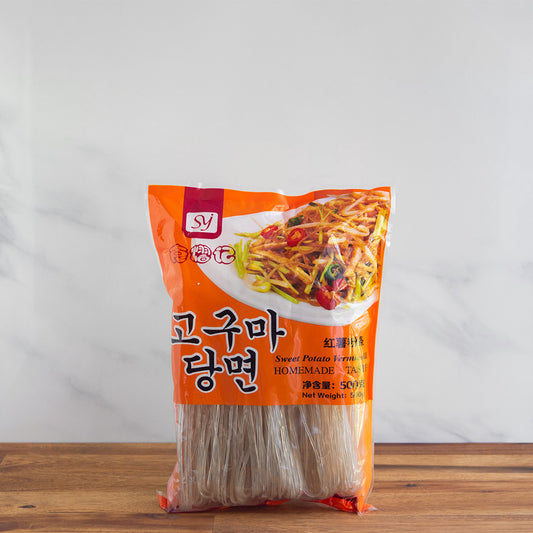
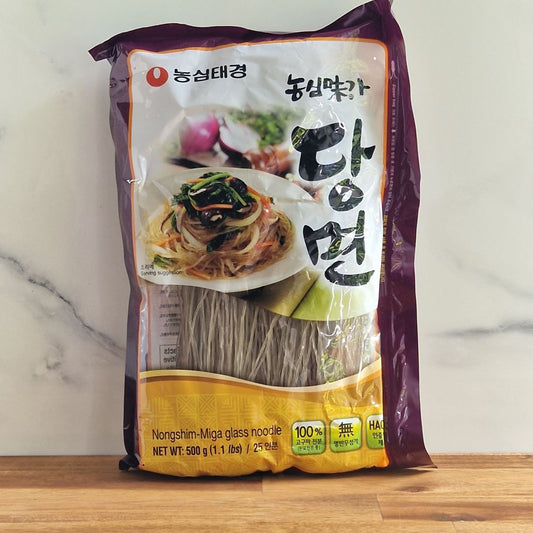
The collection is built on two 500 g products: Dangmyeon Korea Store 500 g and Nongshim Sweet Potato Noodles 500 g. Both serve the same general purpose: preparing japchae and cooking Korean dishes with sweet potato noodles.
A 500 g packet represents about five 100 g portions. The choice between the two products is therefore made mainly according to the brand and the product characteristics indicated on each packet, rather than according to an artificial ranking.
Dangmyeon is a dry product: it keeps for months at room temperature in a dry cupboard, with no cold chain. To go straight to one of the products in the collection, see the Dangmyeon Korea Store 500 g.